Architecture diagrams, as fast as a whiteboard sketch
Most architecture starts as a sketch. Kelvo keeps that sketchy look, and turns the sketch into boxes and links you can keep editing.
Start drawing, freeNo sign-up. Works in your browser.
Sketch, then convert
Draw boxes, arrows and handwritten labels with the pen (P). Select the strokes and click Convert sketch: Smart Assist reads an image of just those strokes and proposes real boxes and links in their place. Tab replaces the sketch; Esc keeps it as drawn. Holding still at the end of a stroke snaps it into a clean rectangle, ellipse or diamond.
Or describe it
Write the components one per line (or A -> B -> C) in a sticky and click Make diagram. With Pro, type @kelvoand what you want in any box or text, for example “@kelvo add a cache in front of the database”, and press Enter. The change is made right there and the request disappears; one undo takes it back.
Everything a design review needs
- Code blocks with syntax colouring for configs, schemas and prompts
- Tables for requirements and trade-offs: paste CSV and it becomes a table
- Layers to show or hide detail, and with Pro, pages for different views (context, containers, deployment)
- Frames that group services and become slides when you present
- Version history to go back to an earlier state
Start from a template
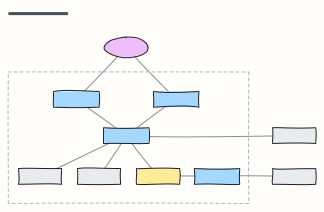 C4 container diagram
C4 level 2: the apps, APIs, databases and queues inside the system boundary, with the technology on each link.
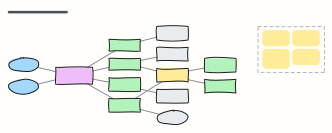 Microservices with API gateway
Clients behind an API gateway, services that each own their database, and an event bus for asynchronous work.
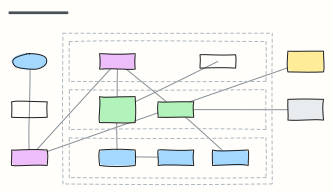 AWS three-tier web app
A highly available web app on AWS: DNS and CDN, load balancer, auto-scaled app servers and Multi-AZ database in a VPC.
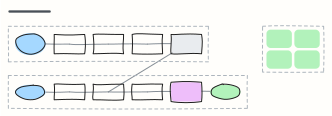 RAG pipeline
Retrieval-augmented generation end to end: ingest and embed documents offline, then retrieve, rerank and answer with citations.
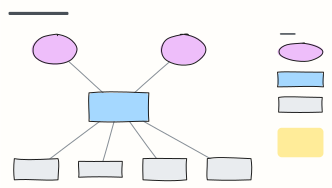 C4 system context diagram
C4 level 1: the system in scope, the people who use it and the external systems it depends on, with a legend.
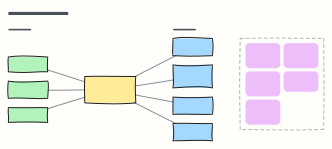 Event-driven architecture
Producers publish facts to a broker; independent consumers react — with the design rules that keep it reliable.
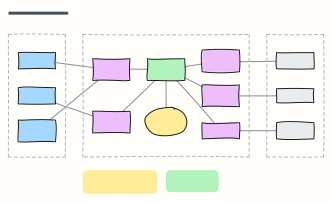 Hexagonal architecture (ports & adapters)
Keep business logic independent: driving adapters call inbound ports, the core uses outbound ports that adapters implement.
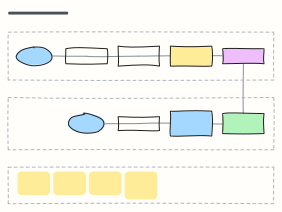 CQRS + event sourcing
Separate write and read paths: commands append events to an event store, projectors build read models for queries.