Build vs buy decision matrix template
Score building, buying SaaS or self-hosting open source against weighted criteria to make the call explicit.
Use this templateFree, opens in your browser. No sign-up.
What is a build vs buy decision matrix?
A build vs buy matrix compares ways of getting a capability, such as building it in-house, buying a SaaS product or self-hosting an open-source project, against the criteria that matter to your team. Each criterion gets a weight and each option a score, and the weighted totals make the trade-offs visible instead of leaving the decision to whoever argues loudest.
The template is a table with the three options as columns (build in-house, buy SaaS, self-hosted open source) and weighted criteria as rows. Beside it are four rules for using it: agree the weights before anyone scores, score 1 to 5 with evidence, build what differentiates you and buy what's commodity, and count engineers and on-call time, not just licences.
What's on the board
- How to use it
- Agree the weights before anyone scores · Score 1–5 per option, with evidence · Build what differentiates you; buy commodity (auth, billing, email) · Count engineers + on-call, not just licences
Table columns: Criterion, Weight, Build in-house, Buy (SaaS), Open source, self-hosted.
How to fill in the build vs buy decision matrix template
- Click Use this template. It opens in the Kelvo app as a new board, saved in your browser. Double-click any box to change its text.
- List the criteria that matter. Typical rows: cost over three years, time to ship, fit with requirements, control and customisation, maintenance and on-call load, security and compliance, and lock-in.
- Set the weights before scoring. Agree the weights as a group first, so nobody adjusts them afterwards to get the answer they wanted.
- Score each option with evidence. Give each option 1 to 5 per criterion and back every score with something concrete: a quote, a prototype, a reference call.
- Count the hidden costs. For building, include engineering time, maintenance and on-call. For buying, include integration, migration and future price rises.
- Write the decision down. Total the weighted scores, check the winner against your instinct, and record the decision and its reasons, for example in an architecture decision record.
When to use it
- Choosing how to get authentication, billing, search, analytics, email or another common capability
- A team proposes building something a vendor already sells, or the other way round
- Presenting a recommendation to leadership with the reasoning attached
When to skip it
- For your core product: if it's what customers pay you for, you'll almost always build it
- For small, reversible choices where the analysis would cost more than getting it wrong
Working on an architecture diagram in Kelvo
- Sketch, then convert
- Draw boxes and arrows with the pen, select the strokes and click Convert sketch: they become real boxes and links.
- Ask Kelvo right on the board (Pro)
- With Pro, type @kelvo and what you want in any box or text, for example “@kelvo add error handling”, and press Enter. The change is made there and the request disappears; ⌘Z undoes it.
Questions
When should you build instead of buy?
Build when the capability sets your product apart, when no vendor meets a hard requirement, or when buying would cost more over a few years than building and running it. Buy commodity capabilities such as authentication, payments or email, where a vendor's focus and scale beat what a small team can do.
How do you compare the total cost of building and buying?
For building: engineering time to build it, then maintenance, infrastructure and on-call, usually over three years. For buying: licence or usage fees at your expected growth, integration work, training and the cost of switching later. Self-hosted open source sits in between: no licence fee, but you run it.
How do you weight the criteria?
Give each criterion a weight, for example 1 to 5 or percentages that add up to 100, before anyone scores. Multiply each score by its weight and add them up per option. If a small change in the weights flips the result, the options are close and other factors can decide.
Related templates
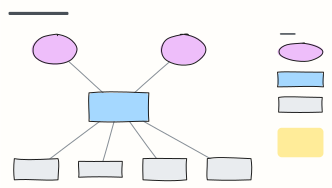 C4 system context diagram
C4 level 1: the system in scope, the people who use it and the external systems it depends on, with a legend.
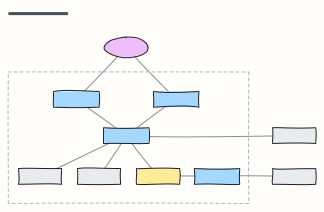 C4 container diagram
C4 level 2: the apps, APIs, databases and queues inside the system boundary, with the technology on each link.
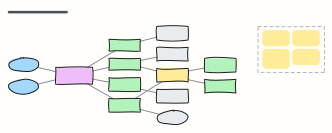 Microservices with API gateway
Clients behind an API gateway, services that each own their database, and an event bus for asynchronous work.
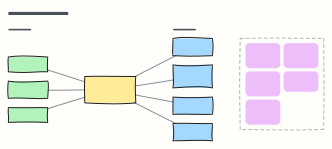 Event-driven architecture
Producers publish facts to a broker; independent consumers react — with the design rules that keep it reliable.
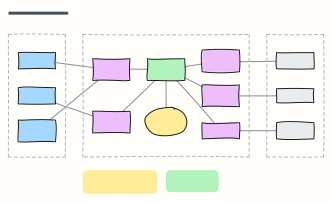 Hexagonal architecture (ports & adapters)
Keep business logic independent: driving adapters call inbound ports, the core uses outbound ports that adapters implement.
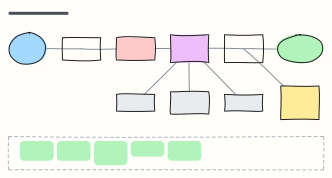 LLM application architecture
Production building blocks around a model: gateway, guardrails, orchestrator, cache, vector DB, tools and observability.