Code review checklist template
What to look for in a pull request, from correctness to security, so reviews are fast and consistent.
Use this templateFree, opens in your browser. No sign-up.
What is a code review checklist?
A code review checklist is a short list of what a reviewer checks on every pull request: does the change do what the ticket asks, is it readable, is it tested, is it safe, and is it ready to merge. Writing the list down makes reviews faster and more consistent, because every reviewer looks for the same things instead of whatever they happen to notice first.
This template groups 20 checks into five sections: correctness, readability, tests, security and performance, and a final “before merge” gate. Keep it short. A checklist that tries to cover everything gets skimmed, so aim it at the problems your linter and CI can't catch.
What's on the board
- Correctness
- Does it do what the ticket asks? · Edge cases: empty, null, huge input · Errors handled, not swallowed · Concurrency / race conditions
- Readability
- Names say what things are · Functions do one thing · Comments explain why, not what · No dead code or debug logs
- Tests
- New behaviour has tests · Bug fix has a regression test · Tests fail without the change · No flaky sleeps or real network
- Security & performance
- Input validated and escaped · No secrets in code or logs · Auth checked on every endpoint · No N+1 queries or unbounded loops
- Before merge
- CI green · Migrations are reversible · Docs / changelog updated · Feature flag for risky changes
How to fill in the code review checklist template
- Click Use this template. It opens in the Kelvo app as a new board, saved in your browser. Double-click any box to change its text.
- Build it with your team. Open the board in a team meeting and ask everyone to add the review comment they leave most often. Those are your real checks.
- Cut what CI already catches. Delete anything a linter, formatter or type checker enforces. Three to five checks per section is plenty.
- Phrase each check as a question. “Errors handled, not swallowed?” is easier to answer than “error handling”. If a check can't be answered from the diff, it doesn't belong here.
- Add your stack's traps. Every codebase has a few, such as missing database indexes, unsafe migrations, forgotten feature flags or bundle size. Add them to the section they belong to.
- Move it into your repository. Once the list settles, paste the checks into your pull request template as checkboxes, and keep the board for discussing changes to it.
When to use it
- Your team is growing and the quality of a review depends on who picks it up
- You're onboarding new reviewers and want to show what a good review covers
- The same kinds of bugs keep reaching production: swallowed errors, N+1 queries, leaked secrets
- You're writing review guidelines or a pull request template
When to skip it
- For anything a tool can enforce, such as formatting, lint rules and type errors. Automate those in CI
- For tiny changes like a typo fix, where reading the diff is enough
Working on an engineering diagram in Kelvo
- Paste a table
- Paste comma- or tab-separated text and it becomes a table. Tab moves to the next cell and adds rows as you go.
- Paste code as code
- Paste a snippet and it becomes a code block with syntax colouring; Tab indents inside it.
Questions
What should a code review checklist include?
The checks that need a person: whether the change does what was asked, edge cases and error handling, naming and structure, tests for new behaviour and bug fixes, security (input validation, secrets, authorization), performance traps such as N+1 queries, and merge readiness: green CI, reversible migrations and updated docs.
How long should a code review checklist be?
Short enough to use on every pull request: 15 to 25 checks across a handful of sections is a sensible ceiling. If reviewers start skipping it, remove the checks that rarely catch anything.
Is the checklist for the author or the reviewer?
Both. Authors run through it before asking for a review, which catches the obvious issues early, and reviewers use it so their feedback covers the same ground every time.
Can I turn it into a GitHub pull request template?
Yes. Copy the checks into .github/pull_request_template.md as Markdown checkboxes (- [ ] Tests fail without the change). GitHub then pre-fills every new pull request with them.
Related templates
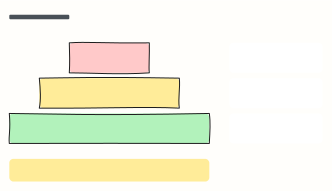 Test pyramid (test strategy)
How many unit, integration and end-to-end tests to write, what each covers, and how fast they should run.
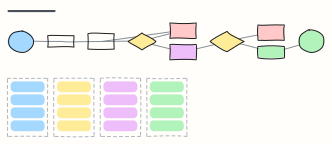 Release process checklist
From code freeze to 100% rollout: the go/no-go gate, canary checks, rollback path and a checklist for every phase.
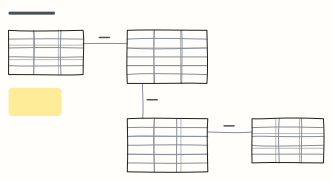 ER diagram (database schema)
Entities as tables with columns, types and keys, joined by one-to-many relationships — sketch a schema before the migration.
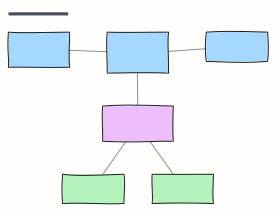 UML class diagram
Classes with fields and methods, associations with multiplicity, and an interface with two implementations.
 Model evaluation plan
Metrics, datasets, targets and owners for evaluating an LLM or ML model, plus the gate a release must pass.
 Feature launch checklist
Everything that has to happen before, on and after launch day, with an owner for each item.