Software engineering diagram templates
The diagrams engineers draw on whiteboards every week: database schemas, class diagrams, state machines, request sequences and branching strategies. Start from a worked example and rename things to match your codebase.
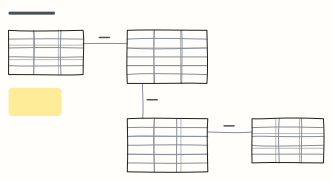 ER diagram (database schema)
Entities as tables with columns, types and keys, joined by one-to-many relationships — sketch a schema before the migration.
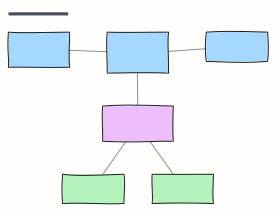 UML class diagram
Classes with fields and methods, associations with multiplicity, and an interface with two implementations.
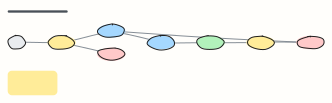 State machine
Every state an order can be in and the events that move it — the source of truth for status logic and tests.
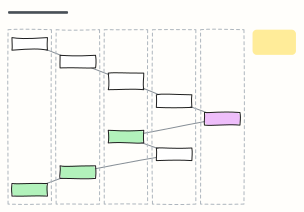 Sequence diagram (request flow)
Numbered steps across Client, API gateway, service, database and a third party — how one checkout request really travels.
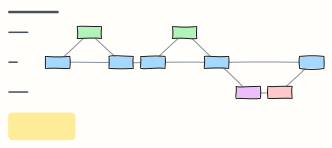 Git branching strategy
Trunk-based development with short-lived feature branches, pull requests, release branches and a cherry-picked hotfix.
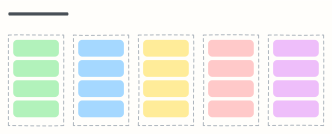 Code review checklist
What to look for in a pull request, from correctness to security, so reviews are fast and consistent.
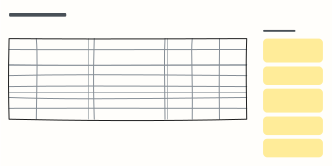 REST API design
An endpoint table — method, path, auth, status codes — plus the conventions every endpoint follows.
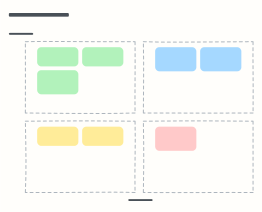 Tech debt prioritization
Sort tech debt by impact and effort so the team fixes quick wins first and plans the big ones.
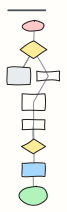 Debugging flow
A disciplined loop for hard bugs: reproduce, write a failing test, isolate, hypothesise, fix the root cause.
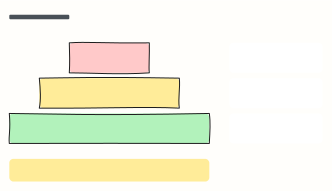 Test pyramid (test strategy)
How many unit, integration and end-to-end tests to write, what each covers, and how fast they should run.
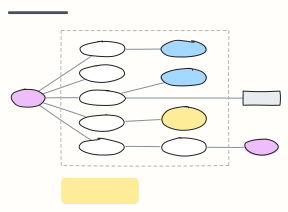 UML use case diagram
Actors, the system boundary and the use cases they take part in, with «include» and «extend» relationships.
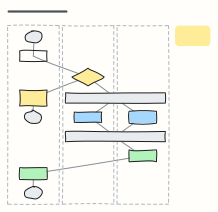 UML activity diagram
An order's activity flow across Customer, Store and Warehouse partitions, with a decision, a fork and a join.
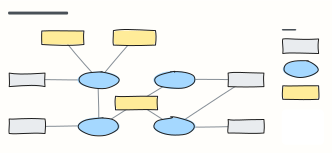 Data flow diagram (DFD)
A level-1 DFD: external entities, numbered processes, data stores and the data that flows between them.
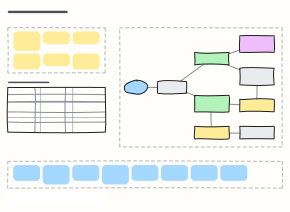 System design interview board
Work a system design question on one board: requirements, estimates, the high-level design and deep dives.
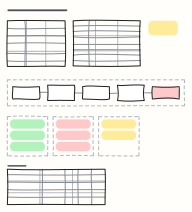 Incident postmortem
A blameless postmortem: summary, timeline, five whys to the root cause, what went well or wrong, and owned actions.
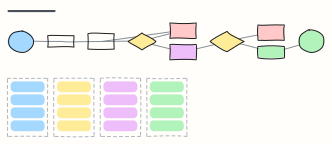 Release process checklist
From code freeze to 100% rollout: the go/no-go gate, canary checks, rollback path and a checklist for every phase.
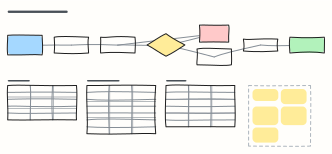 Zero-downtime schema migration
Expand and contract: change a live database schema in small, reversible deploys, with the table before, during and after.
When to use them
- Designing a schema or an API before writing it
- Explaining a tricky flow in a code review or design doc
- Agreeing on team conventions such as branching and reviews
Working on an engineering diagram in Kelvo
- Paste a table
- Paste comma- or tab-separated text and it becomes a table. Tab moves to the next cell and adds rows as you go.
- Paste code as code
- Paste a snippet and it becomes a code block with syntax colouring; Tab indents inside it.
- Link by dragging
- Hover a box and drag one of its dots onto another box. The whole box is the target, and links stay attached when you move things.
- Turn a list into a diagram
- Write one step per line (or A -> B -> C) in a sticky, select it and click Make diagram.