Backend for frontend (BFF) template
One backend per client experience: web, mobile and partner APIs that aggregate shared services, with what each BFF owns.
Use this templateFree, opens in your browser. No sign-up.
What's on the board
- Rules
- One BFF per client experience, owned by that client's team · No business rules in a BFF: aggregate, shape, translate · Auth, rate limits and TLS stay in the gateway · Watch for logic duplicated across BFFs
- Downstream services (shared)
- User service · Catalog service · Order service · Payment service · Recommendations
Table columns: Concern, Web BFF, Mobile BFF.
Also on the board
- What each BFF owns
- Web app (React)
- iOS + Android apps
- Partner integrations
- Web BFF (Node, GraphQL) owned by the web team
- Mobile BFF (Kotlin) owned by the mobile team
- Public API (REST, versioned)
How to use this template
- Click Use this template. It opens in the Kelvo app as a new board, saved in your browser.
- Double-click any box to change its text. Replace the examples with your own content.
- Sketch, then convert. Draw boxes and arrows with the pen, select the strokes and click Convert sketch: they become real boxes and links.
- Ask Kelvo right on the board (Pro). With Pro, type @kelvo and what you want in any box or text, for example “@kelvo add error handling”, and press Enter. The change is made there and the request disappears; ⌘Z undoes it.
- One page per level. Put the C4 context view on one page and the container view on the next, so each diagram stays readable.
Good for
- architect
- bff
- api
- microservices
- patterns
- Agreeing on boundaries and responsibilities between services
- Recording why a design was chosen (and what was rejected)
- Comparing integration options side by side
Related templates
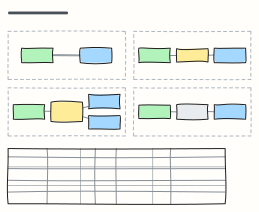 Integration patterns compared
Request/response, queues, pub/sub and batch transfer side by side, with coupling, latency and when to use each.
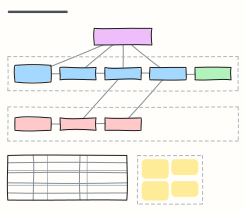 Saga pattern (distributed transactions)
An orchestrated saga: local transactions across services, the compensating steps that undo them, and orchestration vs choreography.
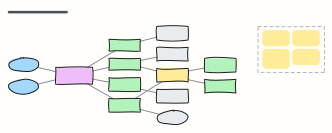 Microservices with API gateway
Clients behind an API gateway, services that each own their database, and an event bus for asynchronous work.
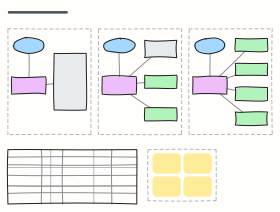 Strangler fig migration
Replace a legacy monolith slice by slice behind a routing facade, in three phases, with a tracker for each slice.
 LLM application architecture
Production building blocks around a model: gateway, guardrails, orchestrator, cache, vector DB, tools and observability.
 Service mesh overview (Istio)
How a service mesh works: sidecar proxies beside every pod, mTLS between services, and a control plane pushing config and certs.